
The Hidden Cost of Discomfort in Decision-Making
The most expensive line in your business isn't on the P&L. It sits in the gap between how clearly people could think on a good day, and how clearly they actually think at three o'clock on a Tuesday, after a morning spent fighting the workspace instead of the work.
A cost that doesn't look like a cost
Most people assume poor seating leads to back pain, eventually. It does. But the bigger cost shows up much earlier, and it doesn't show up on an X-ray. Long before discomfort becomes injury, it quietly erodes focus, patience and decision quality.
Discomfort increases the brain's workload. When posture isn't supported, people spend mental energy stabilising their body or managing fatigue instead of thinking, energy that's no longer available for judgement, creativity or problem-solving. James Clear, whose work on systems has shaped how leaders and athletes worldwide think about performance, puts it simply: you do not rise to the level of your goals, you fall to the level of your systems. The office is part of that system, whether anyone designed it that way or not.
What the research actually shows
Work associated with the National Research Centre for the Working Environment points to strong links between posture, movement and cognitive performance. Interventions that reduce physical strain have been shown to support working memory, response time and perceived mental state in office workers. In experimental settings, people holding static postures for long periods showed measurable declines in creative problem-solving as discomfort increased. Nobody walks out of a bad meeting and says my chair is affecting my executive function. They just describe harder afternoons, shorter patience, and needing more effort for the same work they did easily last week.
Traditional task chairs were built on one assumption: one correct posture, held for most of the day. Nobody works like that any more. Laptops, hybrid calls and second screens have multiplied the postures people move through in a single hour.
Why static sitting is losing the argument
Research led by Professor Peter Vink at Delft University of Technology, alongside recent MIT studies, backs this up. Static upright sitting is getting harder to defend as a design goal. Supported recline and regular movement reduce spinal loading and muscular effort, and optimal support now means enabling a range of postures while keeping the spine supported through every one of them.
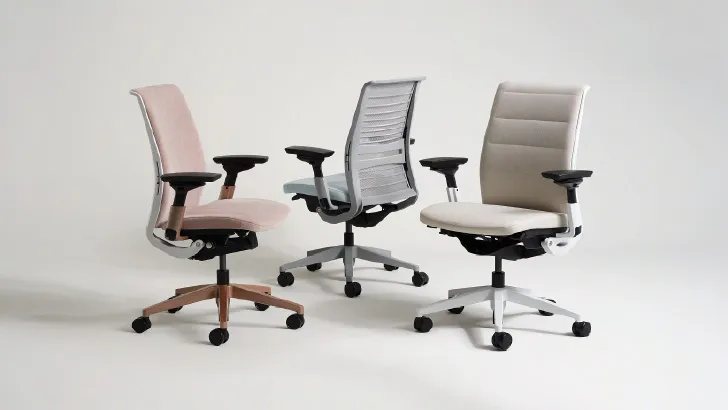
Steelcase's long-running Global Posture Study documented exactly this: modern work involves constant shifts between devices and tasks, and chairs need to accommodate that range rather than enforce one position. That research shaped Steelcase Gesture and Steelcase Series 2, both built to move with the user and hold spinal alignment as posture changes, freeing up cognitive capacity that would otherwise go into propping the body up.
Chairs alone can't solve static load. Height-adjustable desks and active workstations turn posture variation from a good intention into something that actually happens every day. Randomised trials show active workstations can improve reasoning while maintaining attention and memory compared with seated work, and sit-stand studies report reduced fatigue and better subjective focus when prolonged sitting gets regularly interrupted.
What good support actually looks like in practice
None of this requires a wholesale office refit. It usually starts with an honest audit: who's sitting six hours a day in a chair bought for a different role, whose desk height was never actually adjusted after installation, whose second monitor sits at an angle that's been quietly wrecking their neck for a year. Small mismatches compound. A chair with the wrong lumbar setting does the same daily damage as no lumbar support at all, it just takes longer to notice.
The fix is rarely dramatic. A proper fitting session. A monitor arm correctly positioned. A sit-stand desk that actually gets used instead of left flat as an expensive shelf. The return isn't measured in a comfort survey. It's measured in whether the person making a client recommendation at 4pm is thinking as clearly as they were at 9am.
What this means in practice
For finance, legal and professional services firms with lean teams, where every hour of senior judgement counts, this stops being a comfort question and becomes a cognitive one. Task seating and height-adjustable desks are infrastructure for clear thinking, not a procurement line to tick off between the printer and the coffee machine.
Neo Office works with research-led partners including Steelcase to treat furniture as a system, specified around how a team actually works and revisited as roles change, not bought once and forgotten. For leadership, the question shifts from is everyone comfortable to are decisions being made in an environment that supports clear thinking rather than fighting it. That's a fair question to ask before the next big call gets made in a chair nobody's checked in two years.