
Built to Breathe: Why Nature Makes Commercial Sense
For most of human history, people lived outside. Natural light, vegetation, variation in landscape, these were the conditions humans were built for, and no open-plan office has quite replicated them yet. Biologist E.O. Wilson, who developed the biophilia hypothesis, argued that people have an innate tendency to orient towards life and lifelike processes. Put plants and greenery into a workspace, and people respond. Take them away, and something feels quietly off, even if nobody can name what. That instinct turns out to have a commercial value, not just an aesthetic one.
The numbers behind the greenery
In one of the most-cited studies on plants in offices, Dr Marlon Nieuwenhuis at the University of Exeter compared lean offices against enriched environments containing plants. Adding plants to a previously bare space increased productivity by 15 per cent. He was careful to note that the finding challenges lean management orthodoxy, and said so anyway, describing the outcome as pointing towards a more enjoyable, more comfortable and more profitable form of office-based working.
Fifteen per cent isn't cosmetic. In practical terms, it's roughly nine additional minutes of effective output per hour, per person, without extending the working day by a single minute. Across a team of twenty over a year, that's a serious number of hours recovered from nowhere. Workplace wellbeing investments usually get made on instinct. This one has the data to back the instinct up.
Why it works
Environmental psychologist Stephen Kaplan's Attention Restoration Theory explains part of it. Screens, emails and decisions all draw on the same finite cognitive resource, and it runs out faster than most people admit. Natural environments let that system recover. Nature holds attention without demanding it, and cognitive load drops as a result.
It's why green walls, living walls and considered planting schemes do more than improve how a space looks. They change how people feel working in it, hour by hour, across the week, in ways most people never think to credit to the plant in the corner.
The effect isn't limited to desk-based staff either. Reception areas and client-facing rooms benefit just as much, arguably more, since a visiting client forms an impression of a firm's standards in the first thirty seconds inside the door, long before anyone's said a word.
Making it structural, not decorative
The detail that matters most is how greenery gets integrated. Plants placed as an afterthought get treated as one: moved, neglected, forgotten, then quietly binned by whoever's tired of watering them. For the benefits to hold, planting needs to be part of how a space is planned from the start, built into the floor rather than added at the end as a last-minute gesture.
Narbutas CHOICE Storage allows this to happen deliberately, with planter elements built directly into the cabinet structure, softening storage runs within primary sightlines rather than sitting apart from them. Narbutas ROUND Multipurpose brings the same thinking into collaboration settings, with optional planter boxes that add natural texture and colour to everyday meetings.
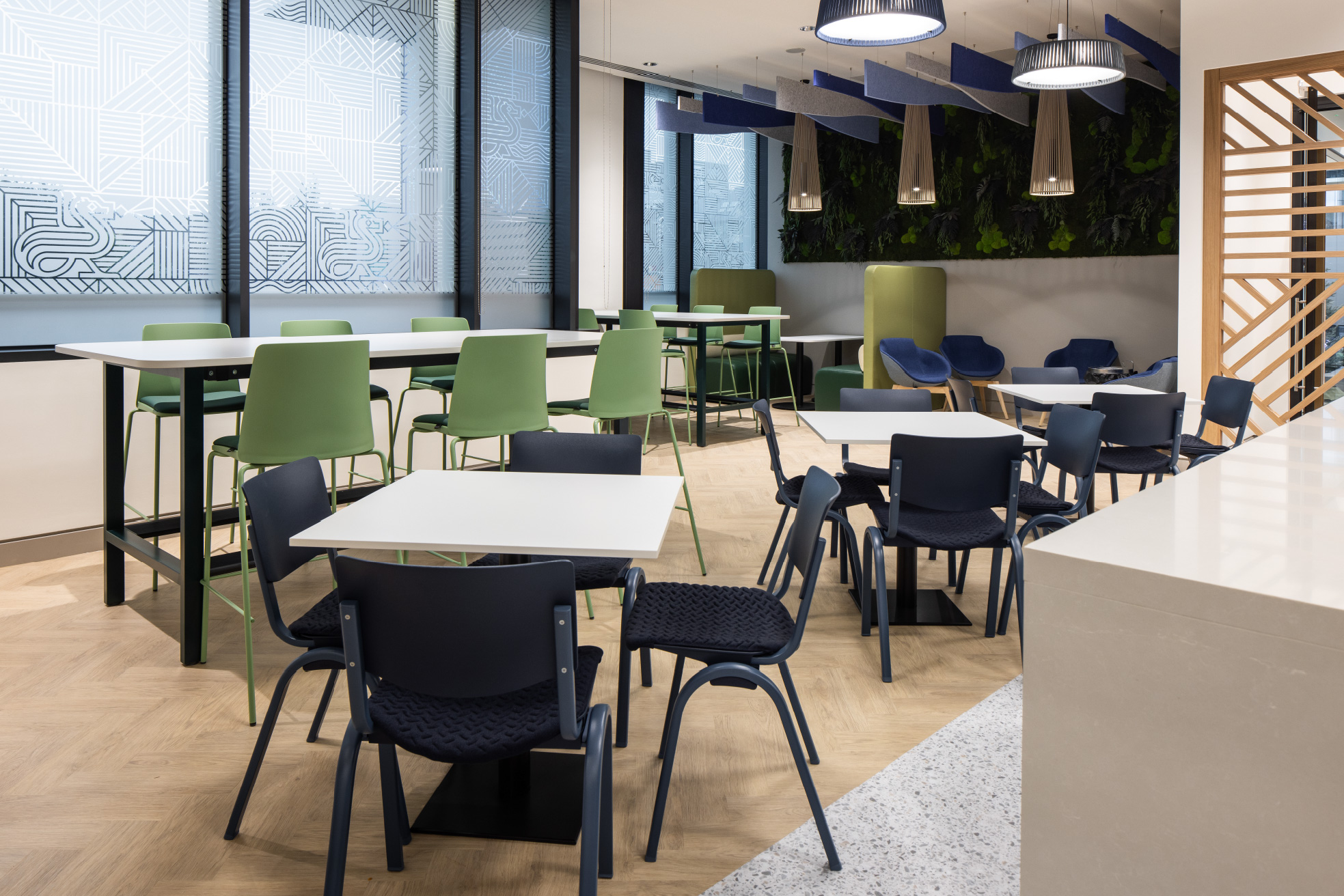
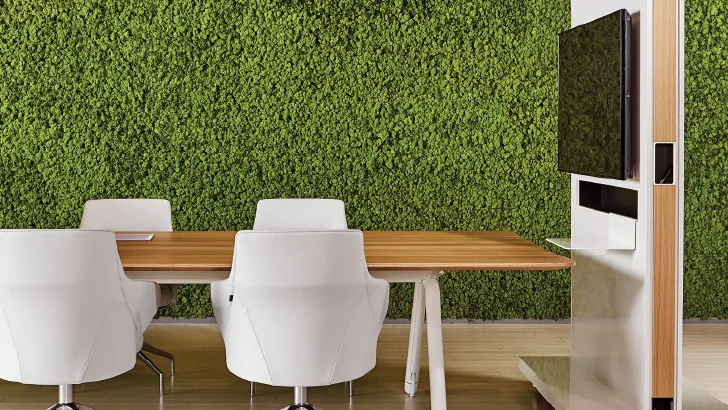
Moss walls deserve a mention of their own. They use preserved rather than live planting, so there's no irrigation, no light requirement and no ongoing maintenance, which makes them a genuinely practical option where a full living wall isn't. They also carry a real acoustic benefit, worth considering alongside other noise-reduction measures in open-plan offices.
Living systems need upkeep, obviously. Neo Office's partnership with Exubia keeps planting schemes professionally specified and maintained, so the benefits hold well beyond installation day rather than fading along with the first dead fern.
The case for competitive workplaces
Finance and professional services firms compete for the same small pool of skilled people, and the physical environment is one of the few differentiators fully within an employer's control. A well-planted office isn't a soft add-on, it's a visible signal to staff and visiting clients that the workplace has been thought through rather than furnished on autopilot. Word about what a workplace is actually like moves fast between candidates who often already know people at the firms they're interviewing with.
Living materials need proper handling too, from delivery through to ongoing maintenance, which is exactly why the specification and upkeep side matters as much as the plants themselves. A living wall that's been poorly installed or left to die does more brand damage than no living wall at all. There is no version of a dying plant wall that reads as intentional.
The commercial case
The argument for biophilic design rests on both evolution and evidence. People have been shaped by natural environments for hundreds of thousands of years, and that doesn't switch off because someone installed carpet tiles. When workplaces reflect even a fraction of that reality, people think more clearly, work more effectively and feel better doing it.
A well-specified office is always judged on how people perform in it. Nature has always been part of that equation, whether the original office design accounted for it or not. If your space hasn't had a planting review, that's a conversation worth having with Neo Office before your next refit.