
AI Raises the Bar for Human Work
Much of the public debate around artificial intelligence still centres on replacement. The people actually building these systems tell a different story: augmentation, not substitution.
NVIDIA's Jensen Huang put it plainly: you are not going to lose your job to AI, you're going to lose your job to someone who uses it. AI isn't a threat, it's a tool, and the advantage sits with whoever picks it up first and uses it well. Microsoft's Satya Nadella calls it a co-pilot, built to extend human capability rather than replace it. OpenAI's Sam Altman makes a similar point: AI lets people do more ambitious things by shifting effort away from routine tasks and toward the thinking that actually matters.
Academic research backs this up. Across industries, automation is increasing, not reducing, the demand for human judgement, creativity and collaboration. The World Economic Forum lists analytical thinking, resilience and creativity among the fastest-rising skills in global demand. AI doesn't replace these abilities. It makes them worth more.
The new demands on the workplace
As AI speeds up information processing, employees spend less time compiling data and more time interpreting it, which is the harder job, not the easier one. Decision cycles shorten and cognitive load increases. Well-designed environments support focus, reduce fatigue and improve the quality of thought, which is exactly why the office has to evolve alongside whatever software just landed on everyone's desktop.
When AI generates ten options in seconds, people need calm, well-designed settings to work out which one is actually good. Ergonomic comfort, acoustic control and lighting stop being nice extras and start acting as performance infrastructure, the same way a server room needs air conditioning.
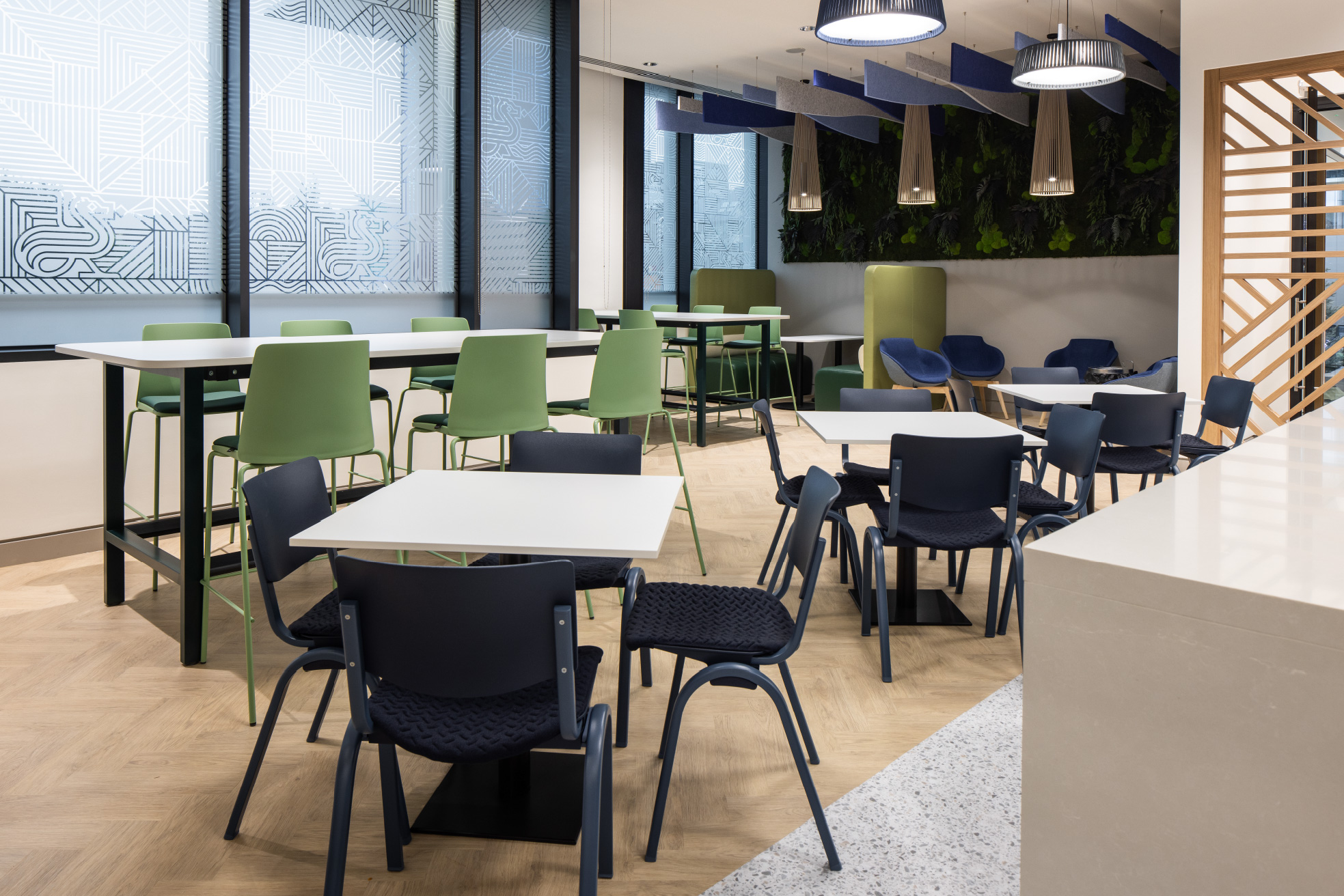
What that looks like in practice is rarely glamorous. It's an acoustic pod near the analyst desks so a fifteen-minute deep-focus block doesn't get swallowed by open-plan noise. It's a monitor arm and a chair that can hold someone comfortably through a two-hour session cross-checking an AI-generated report line by line, because that job now takes longer in concentration even if it takes less time in typing. Steelcase's research into focus and cognitive load has fed directly into settings built for exactly this kind of sustained, high-attention work.
Collaboration, trust and culture
AI can propose answers. It cannot build consensus, and it never will. LinkedIn co-founder Reid Hoffman describes AI as a thought partner, but human partnership still runs on conversation, challenge and shared understanding, none of which happens over a group chat at 11pm. Spaces that support open dialogue, in person and hybrid, sit at the centre of where that value actually gets made.
There's a cultural dimension too. During periods of technological change, trust becomes the thing holding teams together. MIT's Sherry Turkle has argued that digital tools can't replicate the empathy built through genuine human interaction. In an AI-enabled world, the office remains one of the few places that connection can still form properly, which is a strange thing to have to say out loud, but here we are.
What this means for professional services firms
This is directly relevant here. Many firms are already using AI to sharpen efficiency and client service, while competing in a labour market where retaining skilled people is tight and constant. Firms that pair digital ambition with a considered, human-centred workspace send a clear signal, to clients and employees alike, that they've thought about both halves of the equation, not just the half that shows up in a press release.
This matters more for smaller, leaner teams than large ones. A ten-person advisory team competing against a much bigger firm running the same AI tools doesn't win on headcount, it wins on the quality of judgement it applies to what the AI produces. That judgement gets worse in a loud, uncomfortable, badly lit room, no matter how good the model was.
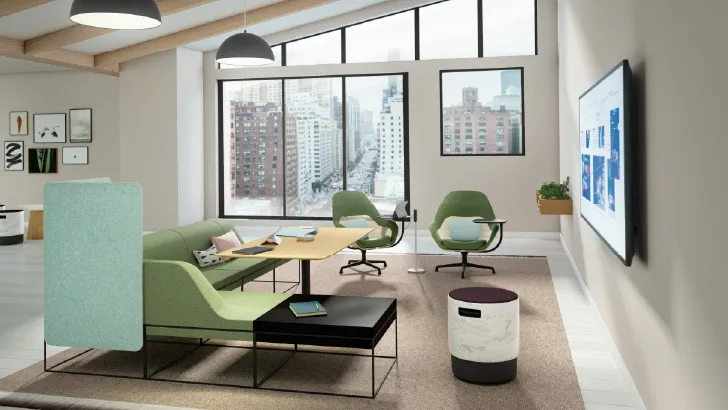
That's where workspace strategy meets technology strategy. Neo Office helps businesses make sure their physical environment matches the work AI now enables, whether that's enclosed focus rooms for deep analysis, sharper collaboration areas for reviewing AI-generated insights, or furniture built for longer, screen-heavy workflows.
A firm that's just rolled out AI tools across a team but hasn't looked at where those conversations actually happen is only half finished. The software was always the easy half.
Humans with machines
The most reassuring part of the AI era might be this: the more capable machines become, the more valuable human qualities become alongside them, creativity, empathy, ethical judgement, leadership. AI can produce output. It can't take responsibility for it, and it never gets asked to.
The future isn't humans versus machines. It's humans with machines, in spaces built to let people think clearly and decide well. If your software budget has grown this year, ask yourself honestly whether your workspace budget has kept pace, or whether everyone's still making decisions from the same tired meeting room. Talk to Neo Office about what that balance should look like for your team.